
MYF Mean in Text: 7 Powerful Meanings, Uses & Examples
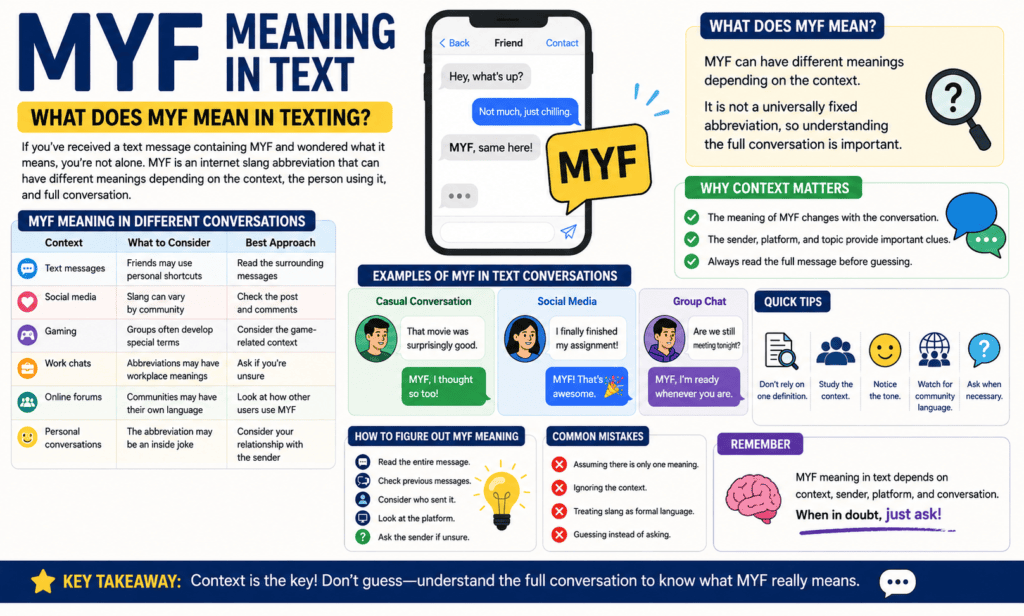
Table of Contents
Introduction
So, you got a text with “MYF” and have no idea what it stands for? Don’t worry—you’re definitely not the only one. Online slang is kind of its own universe, really. Everyone’s always looking for quicker ways to say things, so you end up seeing all sorts of abbreviations like MYF pop up everywhere—texts, social media, comment sections, you name it.
MYF can have different meanings depending on the context.
So, let’s get straight to the point and clear up the confusion around MYF meaning in text.
What Does MYF Mean in Text?
The abbreviation MYF can have different meanings depending on the conversation. There isn’t one single definition that should automatically be applied every time you see these three letters.
MYF doesn’t have just one meaning—it shifts depending on who’s using it and where. People love to make up their own abbreviations, especially online or in group chats. So MYF might mean something different to your friends, your coworkers, or strangers in a gaming lobby. Bottom line: You can’t always figure out what MYF stands for just by looking at those three letters. Guessing could send you in the wrong direction. Context is everything.
For example, if someone writes:
“MYF, that’s exactly what I was thinking!”
the intended meaning may be clear to the people involved in the conversation because they already understand the abbreviation.
However, if you simply see MYF without any surrounding words, there may not be enough information to identify the intended meaning with complete confidence.
Why Context Matters
Context is the biggest clue when trying to understand an unfamiliar abbreviation.
Look at:
- The sentence where MYF appears
- The messages before and after it
- The relationship between the people chatting
- The subject of the conversation
- The website or app where it appears
- Whether the conversation is casual, professional, humorous, or technical
In other words, don’t judge a three-letter abbreviation by its cover. The surrounding conversation usually tells you much more.
MYF Meaning in Different Conversations
One reason internet abbreviations can be confusing is that they aren’t always standardized. A phrase used by one group may be completely unfamiliar to another.
Here is a simple overview:
| Context | What to Consider | Best Approach |
|---|---|---|
| Text messages | Friends may use personal shortcuts | Read the surrounding messages |
| Social media | Slang can vary by community | Check the post and comments |
| Gaming | Groups often develop special terms | Consider the game-related context |
| Work chats | Abbreviations may have workplace meanings | Ask if you’re unsure |
| Online forums | Communities may have their own language | Look at how other users use MYF |
| Personal conversations | The abbreviation may be an inside joke | Consider your relationship with the sender |
This is why a dictionary-style answer isn’t always enough. Understanding MYF meaning in text often requires reading the whole conversation.
Why Do People Use MYF and Other Text Abbreviations?
Text abbreviations became popular because people wanted to communicate quickly. This was especially important when texting required typing on small mobile phone keyboards.
Even though modern smartphones make typing much easier, abbreviations haven’t disappeared. In fact, they’re now deeply connected to online communication.
People use short forms because they can:
- Save time
- Make messages shorter
- Sound casual
- Fit within limited spaces
- Add humor or personality
- Match the style of friends
- Make conversations feel informal
For example, people commonly use short forms such as “IDK,” “BTW,” “TBH,” and “IMO.” These expressions have become part of everyday digital communication.
MYF can work in a similar way when the people in a particular conversation understand what it represents.
How to Figure Out the MYF Meaning in Text
If someone sends you a message containing MYF and you don’t know what it means, don’t panic. You can usually work it out by following a few simple steps.
Read the Entire Message
Don’t focus only on MYF. Read the complete sentence.
For example, compare these situations:
Message A:
“MYF, I can’t believe that happened!”
Message B:
“We need to finish this project today. MYF.”
The surrounding words may provide clues about whether the abbreviation is being used casually, emotionally, humorously, or in a specific community.
Check the Previous Messages
Sometimes the meaning becomes obvious when you look at what was said earlier.
A person may introduce an abbreviation in one message and then use it several times afterward. If you’ve only looked at the latest message, you could easily miss the explanation.
Consider Who Sent It
Think about the sender.
Is it:
- A close friend?
- A family member?
- A colleague?
- Someone from an online community?
- A gamer?
- A social media follower?
Different groups often have different communication habits.
Look at the Platform
The platform can also provide a useful clue.
An abbreviation appearing in a gaming chat may have a different meaning from the same letters appearing in a casual text message. Likewise, social media communities sometimes create their own slang.
Ask the Sender
There’s absolutely nothing wrong with asking.
You can simply say:
- “What does MYF mean here?”
- “Sorry, what do you mean by MYF?”
- “What does MYF stand for?”
- “I haven’t seen that abbreviation before. What does it mean?”
A quick question is much better than replying to a meaning you guessed incorrectly.
Examples of MYF in Text Conversations
Because MYF can be context-dependent, examples should be treated as illustrations rather than proof that one definition applies everywhere.
Casual Conversation
Person A: “That movie was surprisingly good.”
Person B: “MYF, I thought so too!”
Here, the exact meaning has to be understood from the conversation and the way the two people normally communicate.
Social Media Conversation
User A: “I finally finished my assignment!”
User B: “MYF! That’s awesome.”
Again, the surrounding conversation is the key to understanding the abbreviation.
Group Chat
Friend 1: “Are we still meeting tonight?”
Friend 2: “MYF, I’m ready whenever you are.”
If the abbreviation is unfamiliar to one member of the group, they should check with the others instead of assuming its meaning.
These examples show an important point: MYF meaning in text isn’t always something you can calculate from the letters alone.
Is MYF a Common Texting Abbreviation?
MYF isn’t as universally recognized as some major texting abbreviations.
For example, many internet users immediately understand:
- LOL
- BRB
- OMG
- BTW
- IDK
- FYI
- TBH
- IMO
MYF may be less familiar to a general audience. That’s why the surrounding context becomes especially important.
Internet language changes quickly. A term can be popular in one online community while being almost unknown somewhere else.
This also explains why different websites may provide different definitions for the same abbreviation.
MYF Meaning in Text vs. Other Internet Slang
It’s useful to understand how MYF compares with more established internet abbreviations.
| Abbreviation | General Recognition | Context Important? |
| LOL | Very common | Sometimes |
| OMG | Very common | Sometimes |
| BRB | Common | Sometimes |
| IDK | Very common | Usually easy to understand |
| BTW | Common | Usually |
| TBH | Common | Usually |
| MYF | More context-dependent | Yes |
The table shows why you should be careful when interpreting MYF. Some abbreviations have widely accepted meanings, while others depend more heavily on the community using them.
Can MYF Have a Different Meaning?
Yes. This is one of the most important things to understand.
Acronyms and abbreviations can have several meanings. A particular set of letters may represent one phrase in everyday texting and something completely different in business, education, technology, medicine, or another specialized field.
Therefore, if you find MYF in a professional document, academic paper, website, or technical discussion, don’t automatically assume it has the same meaning as it does in a casual text.
Always consider the subject first.
A Simple Rule
Think of it this way:
Same letters + different context = potentially different meaning.
That’s a handy rule for understanding online language.
How MYF Is Used on Social Media
Social media has played a major role in the growth of internet slang.
People want captions and comments to be short, quick, and easy to type. This has encouraged the use of abbreviations, emojis, acronyms, and shortened expressions.
A person may also use MYF because:
- Their friends already understand it
- They want to sound informal
- They’re following a community trend
- They are using an inside joke
- They want to make a message shorter
- They picked up the abbreviation from another platform
However, social media language can spread quickly. An expression that begins inside a small group can eventually become more widely recognized.
That’s why the meaning of slang can change over time.
How to Respond When You Don’t Understand MYF
Suppose someone sends you a message containing MYF, and you’re scratching your head.
The easiest solution is to ask.
Here are some natural replies:
Friendly:
“Hey, what does MYF mean?”
Casual:
“Wait, what’s MYF? 😂”
Polite:
“Could you explain what you mean by MYF?”
Professional:
“I’m not familiar with that abbreviation. Could you clarify?”
There’s no need to feel embarrassed. Internet slang changes so quickly that even people who spend a lot of time online can come across unfamiliar abbreviations.
Common Mistakes When Interpreting MYF
People often make the same mistakes when trying to understand unknown text abbreviations.
Assuming There Is Only One Meaning
This is probably the biggest mistake.
Just because one website gives an abbreviation a particular definition doesn’t mean that’s what the sender intended.
Ignoring Context
Looking at MYF by itself can be misleading.
Always read the full sentence and, if possible, the messages around it.
Treating Slang as Formal Language
Texting slang is usually informal. It may not be appropriate for a school assignment, business report, legal document, or professional email.
Guessing Instead of Asking
If the meaning affects the conversation, it’s better to ask.
A five-second clarification can prevent a very awkward misunderstanding.
MYF Meaning in Text: A Quick Comparison
Here’s a quick guide to help you interpret unfamiliar abbreviations.
| Question | Why It Matters |
| Who sent it? | Different people use different slang |
| Where did you see it? | Platforms have different communities |
| What was being discussed? | Topic provides useful clues |
| What came before it? | Earlier messages may explain it |
| What came after it? | Later messages can reveal the intended meaning |
| Is the conversation formal? | Formal settings may use specialized abbreviations |
| Can you ask the sender? | Direct clarification is the safest option |
This method works not only for MYF but for almost any unfamiliar abbreviation.
Why Internet Slang Keeps Changing
Language has always changed. People create new words, shorten old ones, and borrow expressions from different communities.
The internet simply makes this process much faster.
A phrase can appear in one group today and spread across thousands of users tomorrow. Social media, messaging apps, gaming platforms, and online communities all contribute to this change.
Young people especially tend to experiment with language. They may shorten phrases, remove vowels, combine words, or create new expressions.
That’s why keeping up with internet slang can sometimes feel like trying to catch a moving train.
The good news is that you don’t need to know every abbreviation. Understanding context is a much more useful skill.
Is It Safe to Use MYF in a Message?
Using an abbreviation is generally fine in casual conversations when the other person understands it.
However, be more careful in formal situations.
MYF May Be Suitable For:
- Casual texting
- Friendly group chats
- Social media comments
- Informal online communities
- Conversations with people who already know the term
Be Careful Using It In:
- Job applications
- Formal emails
- School assignments
- Business reports
- Academic writing
- Official documents
When writing professionally, clear language is usually the better choice.
Tips for Understanding Modern Text Slang
If you often come across unfamiliar internet expressions, these simple habits can help.
Don’t Rely on One Definition
Different sources may list different meanings. Compare the definition with the actual sentence.
Study the Context
Context is often more valuable than the abbreviation itself.
Notice the Tone
Is the sender joking, asking a question, complaining, celebrating, or giving information?
Tone can provide another important clue.
Watch for Community-Specific Language
Gaming communities, fandoms, social media groups, and professional communities often develop their own vocabulary.
Ask When Necessary
There’s no prize for pretending to understand something you don’t.
A simple question can clear things up immediately.
Frequently Asked Questions About MYF Meaning in Text
What does MYF mean in text?
MYF can have different meanings depending on context. It isn’t always a universally standardized texting abbreviation, so the sentence, sender, platform, and conversation should be considered before deciding what it means.
Is MYF a slang word?
MYF can be used as an abbreviation or acronym in informal digital communication. However, its exact meaning depends on the community and context in which it appears.
Is MYF commonly used in texting?
MYF is not as universally recognized as abbreviations such as LOL, OMG, or BRB. Some people may use it regularly, while others may not recognize it at all.
Can MYF have multiple meanings?
Yes. Abbreviations can have different meanings in different conversations, industries, online communities, and situations.
What should I do if someone texts me MYF?
Read the surrounding message first. If you still don’t understand it, simply ask the sender what they mean.
Can I use MYF in professional writing?
It’s usually better to avoid unfamiliar texting abbreviations in professional writing. Use clear, complete words unless the abbreviation is officially accepted in your workplace or field.
Does MYF have the same meaning everywhere?
No. Internet slang isn’t always standardized. The intended meaning can change depending on the speaker, community, platform, and subject.
Why are texting abbreviations so popular?
They make communication faster and more casual. They can also help people express personality, humor, and familiarity.
Final Thoughts on MYF Meaning in Text
Understanding MYF meaning in text isn’t always as simple as finding three letters and assigning one definition to them. Modern digital communication is flexible, creative, and constantly changing. An abbreviation that makes perfect sense to one group may leave another person completely confused.
The best approach is to look at the full conversation. Consider the sender, the platform, the subject, and the tone. If the meaning still isn’t clear, asking for clarification is the safest and easiest option.
Most importantly, don’t assume that every abbreviation has one fixed meaning. Internet language is full of shortcuts, inside jokes, community terms, and expressions that evolve over time.
So, the next time you see MYF meaning in text, take a moment to check the context before jumping to a conclusion. Once you understand how digital slang works, unfamiliar abbreviations become much easier to figure out—and a whole lot less mysterious.